
International expansion often looks successful on paper. The product is competitive, demand exists, and early deals are closed. Yet in many B2B growth initiatives, momentum slows shortly after the first contracts are signed. Customers struggle to adopt at scale, value realisation is delayed, and engagement weakens well before renewal discussions begin.
These challenges are frequently explained through product gaps, pricing friction, or onboarding design. In reality, they could be more structural. Customer Success strategies that work in one market do not automatically work in another. When cultural context is overlooked, post-sale execution becomes misaligned, and international expansion stalls; not at market entry, but in sustained growth.
At Metheus Consultancy, we consistently observe that companies treat Customer Success as a universal function. Go-to-market models are localised, sales messaging is adapted, and pricing is recalibrated; yet post-sale engagement is assumed to work everywhere in the same way. This assumption is costly. Customer Success sits at the intersection of trust, communication, accountability, and long-term partnership; precisely the dimensions most shaped by culture.
From Market Entry to Sustained Growth: The Post-Sale Gap
The Post-Sale Gap
In domestic markets, Customer Success benefits from shared cultural context. Teams intuitively understand how frequently to engage, how direct to be, and what signals credibility. Expectations around decision-making, ownership, and escalation are rarely articulated because they are implicitly understood by both sides.
As companies expand internationally, this shared understanding disappears. Practices that once felt like best practice can quickly become misaligned. A fast, highly automated onboarding may be interpreted as efficiency in one market and as lack of commitment in another. Proactive check-ins may be welcomed as partnership in some cultures and perceived as pressure or micromanagement in others. When these mismatches occur, customers rarely raise objections openly. Instead, adoption slows, engagement weakens, and churn risk quietly increases.
The problem is not execution quality. It is cultural misalignment. Customer Success is often the first function where this misalignment becomes visible, and the place where its impact compounds fastest.
Why Global Customer Success Models Often Struggle to Scale
The Assumption of Universal Success
To manage complexity at scale, many B2B organisations deploy a single global Customer Success playbook. From an operational standpoint, this appears sensible: standardised onboarding, uniform KPIs, and centralised tooling promise efficiency, control, and predictability. Implicitly, however, this approach assumes that customers define and evaluate “success” in the same way across markets.
They do not.
Efficiency Does Not Equal Value Everywhere
Research on cross-cultural communication published by Northeastern University highlights that meaning, value, and intent are shaped by cultural context, not simply by outcomes or performance metrics. The research explains that people from different cultures interpret actions, signals, and results through distinct frames of reference, influenced by factors such as communication norms, hierarchy, relationship orientation, and expectations around authority and trust. As a result, the same operational improvements—faster processes, higher automation, or cost efficiency—may be perceived as progress in one market and as disengagement or risk in another.
In Customer Success terms, this helps explain why a globally consistent onboarding or renewal process can strengthen retention in one region while quietly eroding trust in another. Efficiency alone does not translate into perceived value everywhere. When Customer Success playbooks are built around a single definition of success, they overlook how customers in different cultural contexts experience commitment, partnership, and credibility.
The challenge, therefore, is not choosing between global consistency and local relevance. It is designing a Customer Success model that intentionally integrates both, combining shared standards with culturally informed execution.
Culture as a Determinant of Customer Success Outcomes
Structural, Not Cosmetic, Differences
Across international B2B expansions, cultural factors shape Customer Success at a structural level; not only through etiquette or communication style, but through how organisations operate, make decisions, and define success.
When management practices are misaligned with local cultural expectations, the impact is rarely immediate or visible. Instead, coordination weakens, trust erodes, and performance declines gradually over time. In Customer Success contexts, this often results in delayed decision-making, muted feedback, and declining engagement, even while surface-level success metrics appear healthy.
Decision-Making, Communication, and Trust
Decision-making structures play a critical role in this dynamic. In more hierarchical cultures, senior sponsorship is essential, and Customer Success engagement limited to operational users may stall renewals or block expansion. In more decentralised cultures, by contrast, the primary challenge becomes aligning multiple stakeholders with differing priorities and success criteria.
Communication norms further compound these effects. Direct, explicit communication may signal transparency and competence in some markets, while being perceived as over-assertiveness or insensitivity in others. Indirect communication, where objections are implied rather than stated, can easily be misread as agreement. When Customer Success teams fail to recognise these differences, dissatisfaction often remains unspoken until it eventually materialises as churn.
Trust formation also varies significantly across regions. In some markets, credibility is earned through data, benchmarks, and clear ROI articulation. In others, trust is built through continuity, responsiveness, and personal accountability over time. In such contexts, expansion discussions rarely progress before a sufficient level of trust is established, regardless of adoption or usage metrics.
Customer Success, in this sense, functions as a cultural interface between the company and the market; translating global intent into locally perceived value.
Value Is Culturally Defined, So Is Customer Success
Why the Path to Value Is Local Even When the Product Is Global?
These principles manifest differently by geography.
Across much of Europe, Customer Success tends to be process-oriented. Customers value clarity, documentation, and predictable milestones. Confidence is built through governance and risk mitigation, and value is demonstrated through operational efficiency.
Across MENA, relationships play a more central role. Senior stakeholder involvement and continuity are critical, particularly early in the relationship. Once trust is established, however, expansion can accelerate rapidly.
In the United States, Customer Success is typically outcome-driven. Buyers expect early articulation of ROI and clear links between product usage and business impact. Expansion discussions are closely tied to measurable commercial outcomes.
In each case, the product may be global, but the path to value is distinctly local.
Why Customer Success Must Reflect Local Value Perception?
This dynamic is reinforced by analysis published by Forbes, which emphasises that value itself is culturally relative in global expansion. Organisations often assume that customers evaluate value primarily through efficiency, innovation, or cost. In practice, value may be defined by reliability, risk reduction, executive visibility, or long-term partnership depending on the market.
For Customer Success teams, this has direct implications. High usage or fast onboarding does not automatically translate into perceived success. In some markets, customers may value slower but more relationship-driven engagement, while in others they prioritise autonomy and speed. When Customer Success metrics fail to reflect these differences, organisations risk optimising for activity rather than impact.
This explains why globally standardised success metrics can produce misleading signals; high adoption paired with weak renewal confidence, or strong engagement without expansion momentum.
A Structured Way to Localise Customer Success Without Losing Control
Designing for Scale and Cultural Fit
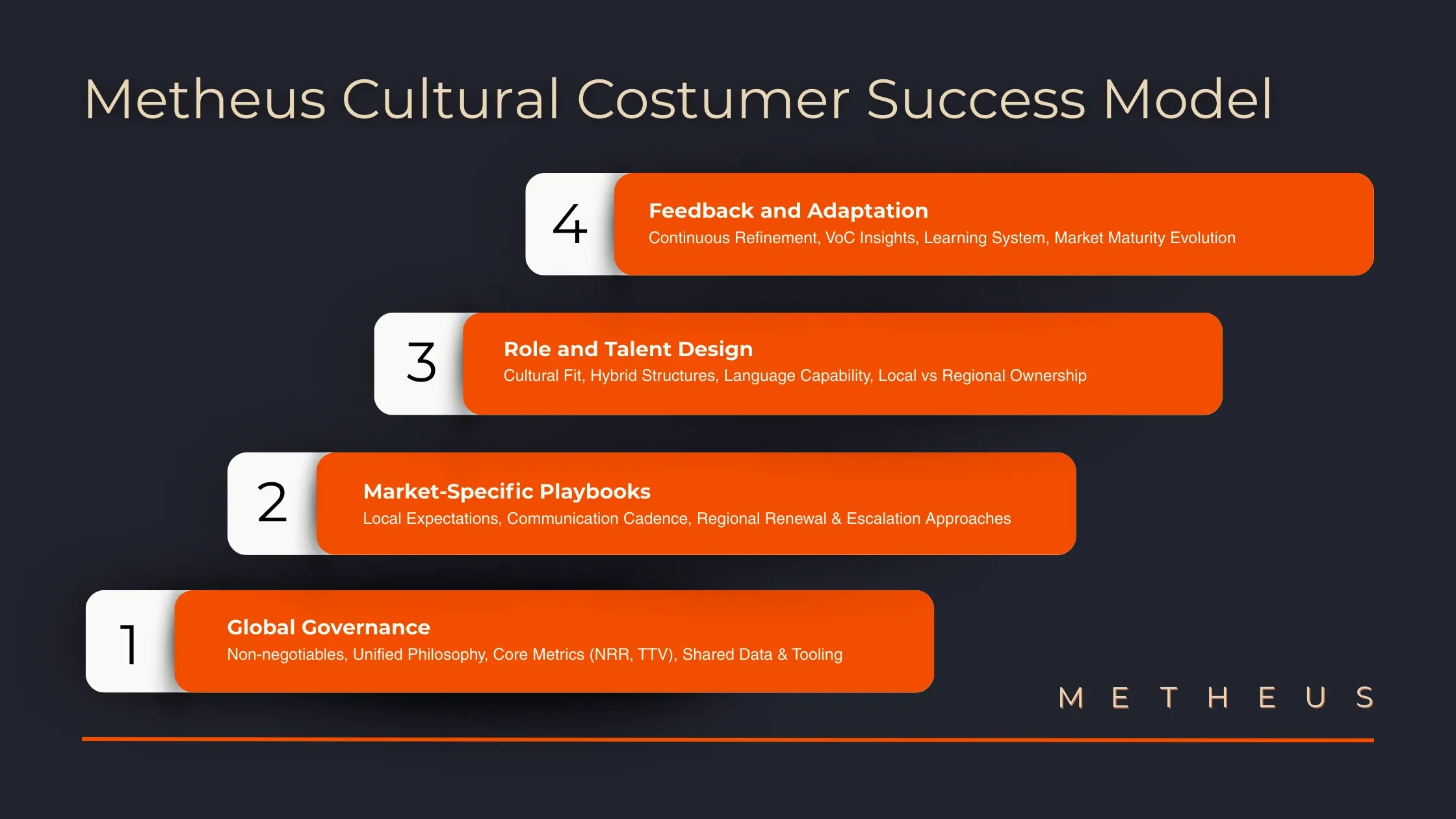
High-performing organizations do not respond to international complexity with fragmentation. Instead, they adopt structured localisation; an approach that balances global consistency with local relevance. At Metheus, we implement this through a four-layer Customer Success model that allows post-sale execution to scale across markets without compromising strategic control.
Layer 1: Global Governance
This layer establishes the global foundations of Customer Success and defines what must remain consistent across all markets. It ensures that, regardless of geography, Customer Success is anchored to the same strategic intent and measured through a common lens.
A unified Customer Success philosophy that clarifies the role of CS in growth, retention, and expansion
Core global KPIs such as Net Revenue Retention (NRR), Gross Revenue Retention (GRR), and Time-to-Value (TTV)
A shared data, tooling, and reporting backbone that enables cross-market visibility
By setting these non-negotiables centrally, organizations create consistency and comparability across regions while avoiding fragmented definitions of success.
Layer 2: Market-Specific Playbooks
Within global guardrails, Customer Success execution is adapted to reflect local expectations, operating norms, and cultural context. This layer translates global standards into locally relevant ways of working.
Onboarding journeys designed around local perceptions of speed, commitment, and trust-building
Communication cadence and tone adjusted to regional norms, including preferences for formality, frequency, and channels
Renewal, escalation, and expansion approaches aligned with local decision-making dynamics and stakeholder structures
Localization at this level is intentional and documented, ensuring relevance without introducing inconsistency or dependency on individual judgement.
Layer 3: Role and Talent Design
The third layer focuses on who delivers Customer Success and how teams are structured to ensure cultural fit and execution quality. Decisions at this level directly influence how Customer Success is experienced by customers.
Clear definitions of local versus regional ownership, including escalation paths and decision rights
Language capability and cultural fluency embedded into role requirements, not treated as optional skills
Hybrid HQ–local team structures that combine central expertise, shared standards, and local market proximity
In practice, these hybrid models consistently outperform purely centralized or fully local setups, particularly in complex B2B and enterprise environments.
Layer 4: Feedback and Adaptation
The final layer ensures that Customer Success evolves as markets mature and customer expectations change. Rather than treating playbooks as static, this layer institutionalizes learning and adaptation.
Market-level performance analysis to identify divergence in adoption, engagement, and retention across regions
Voice-of-Customer insights captured and analysed by geography, segment, and maturity stage
Continuous iteration of Customer Success playbooks based on qualitative feedback and quantitative signals
Through this feedback loop, Customer Success shifts from a fixed set of processes to a learning system that adapts alongside customers and markets over time.
Why This Model Works
Together, these four layers allow organizations to scale Customer Success internationally without falling into two common traps: rigid standardization or uncontrolled localization. Global governance provides stability and clarity, while local execution delivers relevance and trust—turning Customer Success into a scalable growth engine rather than a limiting function.
From Retention Function to Growth Engine
When Customer Success Is Culturally Aligned
When Customer Success is culturally aligned, its role extends far beyond retention. Customers reach value faster, renew with greater confidence, and engage more openly in expansion discussions. Cross-sell and upsell opportunities emerge more naturally, while the risk of silent dissatisfaction is significantly reduced.
This requires a shift in measurement. Instead of focusing solely on usage or activity, leaders must assess whether customers are experiencing value in a way that aligns with their cultural and organizational expectations. Adoption without perceived value rarely translates into sustainable growth.
What This Means for Leadership Teams
Customer Success is no longer a downstream support function that follows sales. In the context of international expansion, it becomes a strategic growth system; one that determines whether market entry translates into sustained adoption, renewal, and long-term value creation across regions.
For CEOs and expansion leaders, this reframes the global growth challenge. Scaling internationally is not only about where to sell or how to price, but about how success is defined, delivered, and experienced in different cultural and organizational contexts. This requires embedding cultural intelligence directly into Customer Success design, balancing global efficiency with local relevance, and moving beyond narrow metrics such as adoption or retention. Instead, success must be evaluated through the lens of locally perceived value; how customers define trust, commitment, continuity, and partnership in their own context.
Organizations that perform well internationally recognize this shift early. They do not treat Customer Success as an operational afterthought, nor do they rely on one-size-fits-all playbooks. Instead, they design Customer Success as an operating model that translates global intent into locally meaningful outcomes—ensuring consistency in direction while allowing flexibility in execution. In practice, companies that win globally do not simply localize sales and marketing—they localize success itself.
At Metheus Consultancy, we see international expansion as complete only when customers consistently adopt, renew, and expand at scale. Our work focuses on helping B2B organizations design Customer Success strategies that bridge cultural gaps, align operating models with local realities, and convert international presence into sustainable, repeatable growth.
If your organization is navigating international expansion and evaluating whether your Customer Success model is truly built to scale across markets, we would be glad to continue the conversation. You can contact us to explore how culturally aligned Customer Success operating models can translate global ambition into locally realized value.
How Metheus Can Help
We work with growth-stage and scaling businesses to develop the strategies, systems and market knowledge needed to expand with confidence. Our approach is data-oriented throughout: from feasibility assessment and market entry planning to go-to-market strategy, demand generation and strategic partnerships. We bring deep expertise in market growth and market expansion across the geographies our clients are entering, with one objective in mind: creating the conditions for sustainable, repeatable growth at scale.
References: