
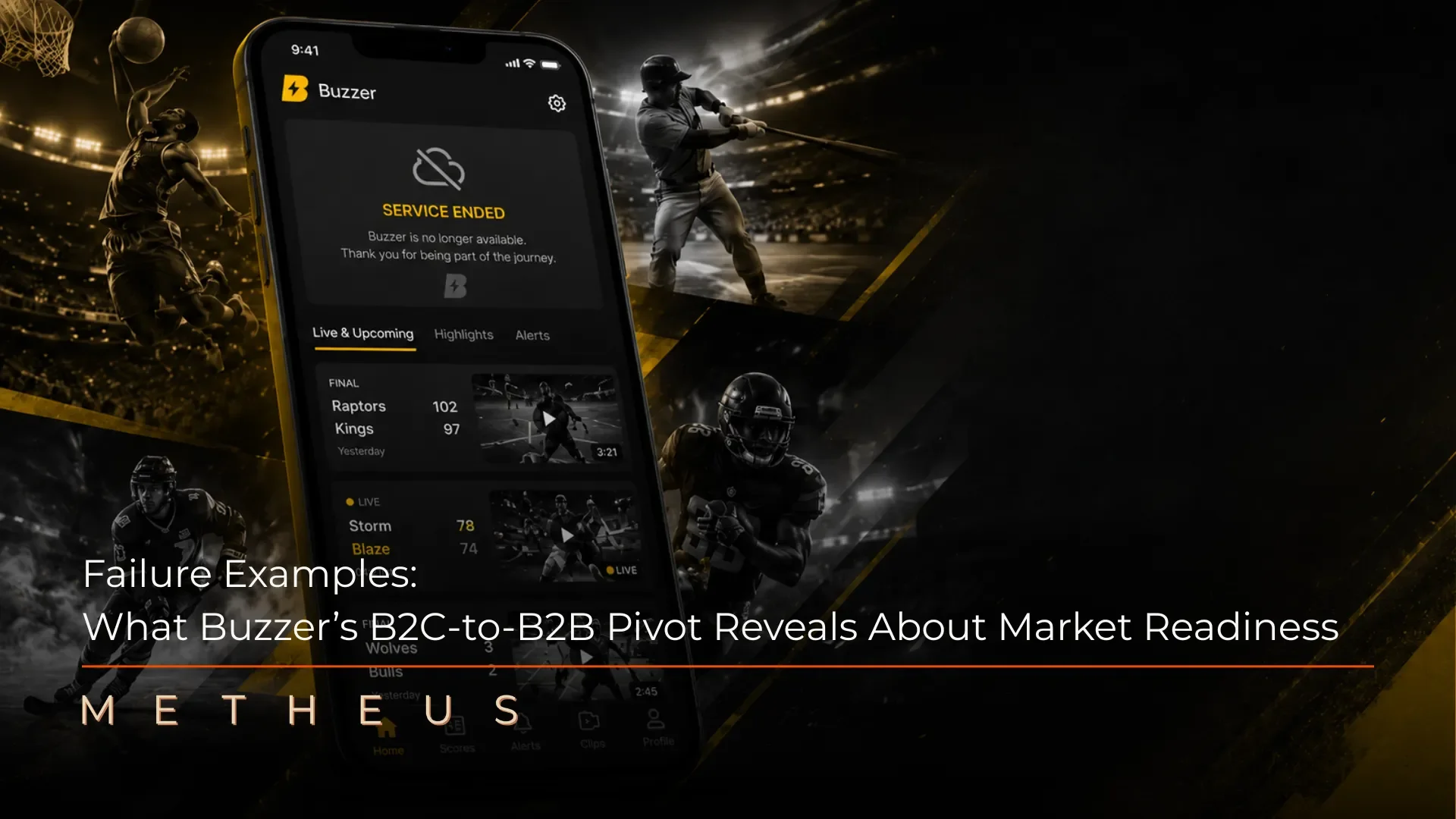
Buzzer launched in 2021 with a clear ambition: to change the way younger fans engage with live sport. Founded by Bo Han, a former director of live content at Twitter, the company was built on a straightforward premise. A significant portion of Gen Z sports fans was not watching full games. They were engaging through highlights, notification-driven moments, social feeds and short live clips, and Buzzer wanted to serve that behaviour directly.
The platform offered users the ability to buy access to brief, high-stakes segments of live sporting events, starting at $0.99 per clip. Rather than committing to a full broadcast subscription, fans could pay for the final minutes of a close NBA game or a critical moment in an NHL match. The company secured rights partnerships with the National Basketball Association (NBA), the National Hockey League (NHL) and the ATP Tour, and raised $44 million in funding from a roster of investors that included Michael Jordan, Kevin Durant and Wayne Gretzky, alongside institutional backers such as Sapphire Sport and Canaan Partners.
By May 2023, Buzzer had shut down its consumer app.
It attempted a pivot to a business-to-business (B2B) licensing model, rebranding its technology offer as 'Powered by Buzzer'. By July 2023, the company had formally wound down all operations.
The central question this article examines is not simply why the app failed. It is this: if Buzzer understood its target audience well enough to attract serious investment, build real rights partnerships and generate genuine industry interest, why was it unable to turn that audience insight into a sustainable commercial model?
The answer involves more than product design or market timing. It sits at the intersection of audience understanding, commercial infrastructure and go-to-market readiness, three things that rarely fail independently and rarely succeed when one is missing.
This is a strategic review of what Buzzer's trajectory reveals about the gap between knowing your audience and building a business that can reliably monetise that knowledge, and what companies in adjacent markets can take from it before they face a similar decision under pressure.
What Was Buzzer Trying to Solve?
Buzzer was not built to replace sports broadcasting. It was built to address a specific gap: the growing number of younger fans who were interested in sport but unwilling or unable to engage with it through traditional formats.
The company's founding logic rested on observable behavioural patterns. Research published by Vizrt in 2023 found that 67% of Gen Z prefer consuming sports content on their phones while on the go, with 37% accessing all their content via mobile devices. Separate data from Morning Consult indicated that 74% of Gen Z acquire sports content through social media. And according to YouGov's Sports Whitepaper from the same year, 34% of young fans aged 18 to 24 prefer highlights over full-game viewing.
Buzzer's founders were looking directly at this audience and building for it.
The problem Buzzer identified had several layers:
Sports rights are fragmented across multiple broadcasters, streaming services and subscription platforms. For a younger fan following several sports, accessing live content often meant holding multiple subscriptions simultaneously.
Mobile-first consumption was already the norm for Gen Z, yet most sports broadcasting remained designed for television and full-game schedules.
The structure of live sports, long games, fixed broadcast windows, regional blackouts and expensive season-long subscriptions, did not map neatly onto how younger audiences actually engaged with content.
Many Gen Z fans were drawn to specific moments within a match: the final quarter, a penalty shootout, a record-breaking attempt, rather than the full event.
Free highlight content, widely available across social platforms, had already trained a generation to expect access without payment.
Against that backdrop, Buzzer's value proposition was clear enough: make live sports more accessible by selling moments rather than events, at a price point more aligned with casual or mobile-first consumption.
The platform offered fans the ability to pay $0.99 for clips of live game streams, with rights partnerships spanning the NBA, the NHL and the ATP Tour, as well as agreements with streaming service DAZN and betting firm FanDuel.
The model reflected a genuine reading of how a segment of sports fans was already behaving. That matters, because it is easy in retrospect to dismiss Buzzer's thesis entirely. The behavioural shift it was responding to was, and remains, real. According to Vizrt's 2023 Viewer Engagement Survey, which polled thousands of sports fans across the UK and US, only 58% of Gen Z watch sports live from start to finish, with many preferring to follow events through clips and mobile-first catch-up content.
The issue was not whether the audience insight was accurate. It was whether that insight could be converted into a commercial model that worked at scale, with the rights infrastructure, pricing mechanics and consumer behaviour changes it would require.
Audience understanding is a necessary starting point for any product. It is not, by itself, a business model.
Why Did the B2C Model Look Attractive at First?
Given what Buzzer understood about Gen Z sports consumption, a direct-to-consumer model was a logical starting point. The company was not trying to compete with broadcasters on the same terms. It was trying to create a new access layer, sitting between fans and the live moments they actually cared about, and charging a small, frictionless fee for that access.
On paper, the logic held.
What made the B2C model strategically appealing?
Direct fan relationship. A consumer app gave Buzzer ownership of the user experience and the data that came with it, including viewing habits, engagement patterns and notification response rates.
Mobile-first design advantage. The product was built for the environment where younger sports fans already spent their time. It did not need to compete for television remote controls.
Personalised alerts and notifications. Buzzer could theoretically alert a user the moment a game entered a decisive phase, a genuinely useful feature for fans who wanted to tune in without monitoring a full broadcast.
Micro-payment access logic. Charging $0.99 for a live moment lowered the commitment barrier significantly compared with full-season subscriptions or pay-per-view events. The unit of sale matched the unit of interest.
Attractive position for rights holders and media partners. Sports leagues and broadcasters were already concerned about declining engagement among younger audiences. A platform designed specifically around Gen Z attention habits offered something the established players were struggling to deliver internally.
Clear differentiation. Buzzer was not replicating an existing product. It occupied a space that no major platform had yet claimed.
The combination of a defined audience, a differentiated product format and a low-friction payment model made the consumer approach appear commercially viable, at least from the outside.
The difficulty is that many of the model's most appealing characteristics carried structural risks that were not immediately visible at the pitch-deck stage.
Direct fan ownership required scale to generate meaningful revenue, and scale required sustained acquisition spend. Personalised alerts were only useful if fans were already habituated to receiving and acting on them. Micro-payments were low-friction for users but also low-value per transaction, which meant the unit economics required a large and active user base to produce reliable revenue. And the appeal Buzzer offered to leagues and media partners was built on an audience it had not yet fully built.
The strengths of the B2C model and the pressures it created were, in many respects, the same thing.
Why Was the Consumer Model So Difficult to Scale?
The challenges Buzzer faced were not unique to the company. They reflected structural conditions that make consumer-facing sports businesses particularly difficult to build from a standing start.
Rights costs set the competitive floor
Sports content is expensive to access and tightly controlled. By the time Buzzer launched, well-capitalised streaming platforms were spending billions annually to secure exclusive rights to major leagues and events. That level of investment set the competitive baseline for what legitimate sports access looked like in the eyes of consumers, and it was far beyond what a venture-backed start-up could sustain independently.
Buzzer's model depended on licensing specific moments rather than acquiring broad rights portfolios, which required ongoing cooperation from leagues and rights holders who held considerable negotiating leverage. As those same leagues began developing their own direct-to-consumer strategies, Buzzer's position in the value chain became harder to defend. A platform that existed to connect fans with live moments had diminishing appeal to rights holders who were increasingly capable of doing that themselves.
Consumer demand and monetisable demand are not the same thing
This is the central commercial tension the B2C model could not resolve. Younger fans were genuinely interested in live sport, but on their own terms: free highlights on social media, clips shared by friends, notification-driven moments. Converting that interest into a recurring willingness to pay requires overcoming habits already reinforced daily by platforms that offer comparable content at no cost.
The micro-payment model was an attempt to lower that conversion barrier. But a sub-dollar access fee is only commercially viable if enough users make enough transactions with enough frequency to cover acquisition costs, rights fees and operational overhead. Sports engagement is inherently event-driven and inconsistent. Users do not watch sport at the same cadence every week, and a model built around moments rather than subscriptions amplifies that variability rather than smoothing it.
The competitive environment was already crowded
By the time Buzzer was building its audience, the landscape for sports content access had already consolidated significantly around larger players with deeper resources. Major technology platforms had moved into exclusive live sports rights. Social media networks were hosting highlights, interviews and real-time commentary at scale. For a Gen Z fan already navigating sport across YouTube, Instagram and TikTok, adding a separate app with a pay-per-moment mechanic represented a meaningful behaviour change, not simply a new user interface.
Each of these requirements looks manageable in isolation. The difficulty is that all five needed to move simultaneously, with limited runway and no guaranteed rights security:
Audience growth. Younger sports fans were already fragmented across social platforms that served sports content at no cost, making paid app adoption a hard first step.
Content access. Premium sports rights were expensive, tightly controlled and increasingly being retained by leagues pursuing their own direct-to-consumer models.
Monetisation. Micro-access transactions do not automatically create repeatable or predictable revenue, particularly when engagement is tied to unpredictable sporting events.
Retention. Sports engagement is event-driven and inconsistent, making habitual app use difficult to build and even harder to sustain between major fixtures.
Distribution. Larger platforms with deeply established user habits dominated the digital environments where Buzzer's target audience already spent their time.
Why Is Sports Streaming Especially Hard for Start-ups?
Sports streaming is frequently discussed as a product challenge. The more accurate framing is that it is a rights, distribution, partnership and infrastructure challenge, with a product sitting on top.
This distinction matters because it changes how a market entry problem should be assessed. A company can build an excellent product and still find the market structurally inaccessible, not because the audience rejects it, but because the commercial conditions required to operate at scale are controlled by other parties.
The rights layer is the most significant barrier
In most consumer markets, a company that builds a better product can acquire customers by outcompeting on experience, price or convenience. Sports streaming does not work this way. The content that makes the product valuable is owned by leagues, federations and broadcasters who license it selectively, at significant cost and on their own terms. A start-up cannot manufacture its own live Premier League match or NBA playoff game. It can only access that content if an existing rights holder agrees to share it, and on terms that may not be commercially viable at an early stage of growth.
This creates a structural dependency that most start-ups in other categories do not face. Product quality and rights access are separate problems, and solving the first does not guarantee progress on the second.
Established ecosystems create high switching costs
Sports fans are not neutral consumers waiting to be acquired. Most already have established habits: a broadcaster they watch on television, a streaming service they subscribe to, a social platform where they follow teams and athletes. Moving a fan from those habits to a new paid platform requires a compelling reason to change behaviour, and that reason must be strong enough to justify both the financial cost and the disruption to existing routines.
The platforms that already hold sports audiences have built those relationships over years, often backed by exclusive rights and significant marketing investment. A new entrant is not simply competing on features. It is competing against inertia, familiarity and the path of least resistance.
League and broadcaster relationships are not easily replicated
Access to sports content is not only a financial negotiation. It is a relationship negotiation. Leagues and broadcasters make decisions about licensing partners based on brand fit, audience reach, financial stability and strategic alignment. A start-up with a compelling concept but a limited track record faces a credibility gap in those conversations that takes time and demonstrated traction to close.
By the time a start-up has built the track record that earns meaningful rights conversations, its runway may already be under pressure.
The market entry lesson
This is where sports streaming connects directly to broader market entry principles. Entering a market with a strong product idea is a very different exercise from entering a market where the commercial infrastructure needed to support that product is accessible and willing to engage.
Target market analysis that stops at audience behaviour, fan demographics and content consumption trends misses the structural layer entirely. The more important questions are: who controls the content supply chain, what are their incentives, and under what conditions would they make that supply available to a new entrant at terms that allow a viable business to operate?
For Buzzer, and for any start-up entering a rights-dependent market, those questions needed answers before the product did.
Why Did Buzzer Shift from B2C to B2B?
In May 2023, Buzzer shut down its consumer app and announced a shift to a business-to-business licensing model, offering its technology to leagues, teams, broadcasters and media partners under a 'Powered by Buzzer' framework. The offering included application programming interface (API) licensing, custom development and consulting services.
It is tempting to read this as a distress move. The more useful reading is that it was a strategic attempt to reposition the company within the sports media value chain, using assets it had already built.
The logic of the shift
Buzzer had spent several years developing technology specifically designed for the sports streaming environment. Its platform could identify trending in-game moments, authenticate viewers, manage live streaming delivery and trigger personalised notifications at scale. These were not generic capabilities. They were purpose-built for a market that most technology providers had not deeply engaged with.
The pivot reframed what Buzzer was selling. Rather than asking fans to change their behaviour and pay for a new access format, the company would sell its infrastructure to organisations that already had the fan relationships, the rights access and the distribution reach that Buzzer had struggled to build independently.
The shift can be summarised as moving from:
owning the fan relationship
to
selling infrastructure to companies that already owned sports audiences.
That is not an irrational move. If the consumer model had demonstrated that the product worked technically, and that fans responded to moment-based live access when prompted correctly, then the underlying technology had proven value. The question was whether a different commercial model could unlock that value more efficiently.
What Buzzer was offering the B2B market
Sports organisations, broadcasters and media platforms face a version of the same problem Buzzer was originally trying to solve: how to engage younger audiences with live sport in formats that suit their consumption habits. A league or broadcaster with existing rights, audience relationships and distribution infrastructure but without the technical capability to deliver moment-based mobile experiences was, in theory, exactly the kind of buyer Buzzer's B2B offer was designed for.
The 'Powered by Buzzer' model was an attempt to turn the company's consumer-facing product into sports media infrastructure. Rather than competing with rights holders, it would serve them.
Why the pivot deserves serious analysis
Many post-mortems on failed start-ups treat a late-stage pivot as evidence of original failure. That framing is too simple. Companies that pivot often do so because they have learned something valuable from their first model that points toward a more viable one. The pivot is not the problem. The question is whether the new market is structured in a way that allows the company to succeed, and whether the company has the time, positioning and resources to pursue it credibly.
In Buzzer's case, the pivot had genuine strategic logic. Whether that logic was matched by the conditions needed to execute it is a separate question.
What Actually Changes When a Company Moves from B2C to B2B?
A pivot from business-to-consumer to business-to-business is often described as a strategic repositioning. In practice, it is closer to building a second company on top of the first, using some of the same technology but very little of the same commercial logic.
The differences are not cosmetic. They run through every part of how the business operates, from how it identifies prospects to how it closes deals, retains clients and demonstrates value over time.
B2C Buzzer
Needed users at scale to generate meaningful revenue
Sold access directly to fans through a consumer app
Relied on consumer engagement habits and notification-driven behaviour
Needed brand trust and recognition among a young, fragmented audience
Measured success through usage metrics and transaction volume
Faced high and sustained customer acquisition costs
Built around fan behaviour and moment-based consumption
B2B Buzzer
Needed enterprise buyers, not mass audiences
Sold technology and infrastructure to sports organisations and media partners
Relied on buyer urgency, procurement cycles and internal budget approval
Needed commercial credibility with decision-makers inside sports organisations
Needed to prove measurable business value to justify licensing investment
Faced longer sales cycles and relationship-dependent deal structures
Built around buyer behaviour and organisational purchasing logic
The contrast matters because it illustrates how much of what Buzzer had built, its brand recognition among fans, its consumer-facing user experience, its notification and engagement mechanics, had limited transferable value in the B2B context. Consumer familiarity does not translate into enterprise credibility. A product that fans find intuitive is not automatically one that procurement teams find compelling.
The sales motion changes entirely
In a consumer model, distribution is largely a function of marketing reach, app store visibility and word-of-mouth. Conversion happens at the individual level and can be optimised through product design, pricing and push notifications. The feedback loop is fast.
In a B2B model, the sales motion is relational, sequential and slow. A potential buyer inside a sports organisation or broadcaster needs to understand the product, assess its fit with existing systems, build an internal case for investment, secure budget approval and navigate procurement processes before a contract is signed. The feedback loop can span months.
The value proposition needs to be rebuilt
Buzzer's consumer value proposition was straightforward: pay a small amount to watch the moments that matter, without committing to a full subscription. That proposition was built around individual fan convenience.
A B2B value proposition for the same underlying technology needs to answer a different set of questions entirely. What operational or commercial problem does this solve for a sports organisation? How does it fit into existing workflows? What does success look like twelve months after implementation? How is the return on investment measured and communicated internally?
These are not variations on the same question. They require a fundamentally different understanding of decision-maker behaviour, buying journeys and what constitutes a credible business case in the sports media sector.
Why Was the Pivot Strategically Logical?
The pivot had a coherent internal logic, and understanding why it made sense on paper is important context for understanding why it failed in practice.
The technology had real and transferable value
Buzzer had spent years building infrastructure specifically designed for live sports streaming. Its platform could identify trending in-game moments algorithmically, manage viewer authentication, deliver live streams at scale and trigger personalised alerts in real time. These were not off-the-shelf capabilities. They were purpose-built for a technically demanding environment, and they worked.
The consumer app may not have reached the scale needed to sustain a direct-to-consumer business, but the technology underpinning it had been tested in live conditions with real sports content and real users. That is a meaningful asset, and it was reasonable to ask whether a different commercial model could extract more value from it.
Sports organisations had a problem Buzzer understood well
The challenge of engaging younger audiences with live sport was not unique to Buzzer. Leagues, broadcasters and teams were grappling with the same question from the other side. They had the rights, the audience relationships and the distribution infrastructure, but many lacked the technical capability to deliver the kind of mobile-first, moment-based experiences that younger fans were gravitating towards.
In that context, a technology provider that had already built and tested exactly that capability was a credible potential partner. Buzzer understood the fan behaviour its prospective B2B clients were trying to influence, and it had product evidence to support that understanding.
Licensing offered a more stable revenue structure
One of the structural weaknesses of the consumer model was its dependency on high transaction volumes and continuous acquisition spend. A licensing model, by contrast, offered the prospect of contracted, recurring revenue from a smaller number of clients. A single meaningful partnership with a league or broadcaster could, in principle, provide more revenue stability than thousands of individual micro-payment transactions.
Strategic partnerships of this kind also carried the potential to open doors to rights conversations that had previously been difficult for Buzzer to access as a consumer-facing intermediary. Operating as a technology partner rather than a competitor for fan attention changes the dynamic of those relationships.
The pivot was an attempt to find the right position in the value chain
Taken together, the case for the pivot was not unreasonable. Buzzer had proven technology, a clear understanding of a problem that sports organisations were actively trying to solve, and a licensing model that could theoretically reduce its dependence on consumer acquisition and rights negotiation simultaneously.
The question was not whether the strategic logic held. It was whether the market conditions, the available runway and the company's positioning were sufficient to allow that logic to play out.
Why Did the B2B Pivot Still Fail?
The strategic logic of the pivot was coherent. The outcome was not. By July 2023, less than two months after shutting down its consumer app and announcing the 'Powered by Buzzer' licensing model, the company had wound down all operations entirely. Understanding why requires looking at the conditions the pivot needed to succeed, and how many of those conditions were absent or insufficient.
The timing may have been too late
A B2B sales cycle in the sports media sector is not a short process. Identifying the right decision-makers inside a league, broadcaster or sports organisation, building a relationship, presenting a business case, navigating internal approval and reaching a signed agreement typically takes months, sometimes longer. Buzzer may not have had the runway to absorb that timeline by the time the pivot was announced.
The pivot was accompanied by a $20 million funding round, which suggested the company was attempting to buy itself enough time to make the new model work. That it wound down within weeks indicates the conditions were more constrained than the funding implied, whether through ongoing operational costs, an inability to close deals quickly enough or a combination of both.
Potential buyers may not have treated the product as urgent
One likely challenge was that sports organisations, while genuinely interested in younger audience engagement, may not have viewed Buzzer's technology as an immediate operational priority. Interest is not the same as urgency, and urgency is what drives procurement decisions in enterprise sales.
A league or broadcaster exploring ways to reach Gen Z fans has many options available, from partnerships with social platforms to internal product development to working with established technology vendors. Buzzer would have needed to position its offering not simply as valuable, but as the most credible and timely solution to a problem the buyer was actively trying to solve right now. That is a harder argument to make from a position of financial pressure and limited time.
The product may have been valuable but not essential
There is a meaningful distinction between a product that a buyer finds interesting and one that solves a problem they cannot reasonably address another way. Buzzer's technology was demonstrably capable, but sports organisations considering a licensing relationship would have assessed it against alternatives, including building similar capabilities internally, partnering with larger and more established technology providers or simply deprioritising the problem until a more proven solution emerged.
A start-up entering a B2B market needs to occupy a position that is not easily substituted. It is not clear that Buzzer had established that position before its runway ran out.
One difficult model may have led to another
The consumer model struggled because of rights dependency, acquisition costs and entrenched competition. The B2B model introduced a different but equally demanding set of requirements: longer sales cycles, relationship-dependent deal structures, the need to demonstrate operational value rather than product appeal and competition from technology partners that sports organisations already knew and trusted.
B2B buyers rarely make purchasing decisions based on product innovation alone. They need a clear business case, budget alignment, internal sponsorship and confidence that the solution integrates with existing workflows and delivers measurable value. Buzzer would have needed to build that case from the ground up, with limited time and a track record built primarily in a consumer context.
Was Buzzer Solving a Real Problem or a Commercially Urgent One?
This question sits at the heart of both the consumer model and the B2B pivot.
Many companies identify genuine behavioural shifts and build products around them, only to find that the market does not yet have a clear or accessible mechanism for purchasing a solution. The shift Buzzer identified was real. Gen Z fans were engaging with sport differently. The problem was that neither the consumer market nor the enterprise market had developed a reliable, scalable way to pay for what Buzzer was offering at the point the company needed it most.
Before executing a pivot, three questions need clear answers:
Who now pays for the product? Identifying a new customer type is not enough. The paying entity needs to be specific, reachable and already allocating budget to problems the product can solve.
Why would they buy it now? Urgency is the variable that separates interest from a signed contract. If the buyer can delay, they usually will.
What internal process does the product need to fit into? Enterprise purchases do not happen in isolation. A product that requires significant workflow change, systems integration or internal advocacy faces a longer and less certain path to adoption.
For Buzzer, the honest answers to these questions may have pointed to a market that was not yet structurally ready to support the pivot, regardless of how sound the technology was or how clearly the company understood the underlying behavioural shift.
What Does Buzzer Reveal About Gen Z Sports Consumption?
Buzzer's failure does not invalidate the audience insight it was built on. The two things are related but not the same, and conflating them leads to the wrong conclusion.
Gen Z fans are engaging with sport differently from previous generations. That shift is visible across every major sports property, and the leagues, broadcasters and platforms actively trying to address it confirms that the underlying behavioural change is real and consequential. Social-first sports discovery, mobile-first viewing, a preference for highlights and clips over full-match commitment, personalised alerts, second-screen engagement and fragmented attention across multiple platforms are all observable patterns that predate Buzzer and have continued well beyond its closure.
Where Buzzer ran into difficulty was not in identifying the shift, but in building a commercial model capable of monetising it at the right time and in the right structure.
The gap between attention and revenue
Attention is not the same as a purchase intent. A Gen Z fan who follows their favourite team across Instagram, YouTube and TikTok is demonstrably engaged with sport. That engagement is real and it has commercial value. But it does not automatically translate into a willingness to open a separate app and pay per moment, particularly when the social platforms already serving that fan offer similar content at no cost.
This is not a generational spending problem. Younger consumers pay for streaming services, gaming, music subscriptions and digital content across many categories. The specific challenge Buzzer faced was converting sports engagement into sports payment in a format that had no established precedent and faced strong free alternatives.
Directionally right, commercially early
The most accurate reading of Buzzer's relationship to the Gen Z sports market is that the company may have been directionally correct but structurally constrained and commercially early.
The behaviours it was building for are increasingly the ones that sports organisations are now trying to serve. The appetite for flexible, mobile-first, moment-based sports access has not disappeared. What Buzzer could not resolve was whether the market, on both the consumer and the enterprise side, was ready to pay for a solution to that problem in the way the company needed it to.
That distinction matters for any company entering a market shaped by a genuine but emerging behavioural shift. Being right about where a market is going is valuable. Being right at the moment the commercial infrastructure is ready to support a new model is what determines whether a business survives long enough to benefit from it.
What Was the Real Lesson from Buzzer's Collapse?
Buzzer's trajectory is useful not because it represents an unusual failure, but because it illustrates a pattern that repeats across sectors and business models. A company identifies a real behavioural shift, builds a product around it, finds the consumer model harder to scale than anticipated and pivots toward enterprise customers in search of a more stable commercial footing.
The pivot itself is rarely the problem. What determines the outcome is whether the conditions needed to make the new model work are actually present when the decision is made.
In Buzzer's case, several of those conditions were uncertain or absent. The sales cycle for enterprise licensing in the sports media sector was long. The potential buyers, leagues, broadcasters and sports organisations, were interested in the problem Buzzer was solving but had no pressing urgency to adopt a new technology partner under a compressed timeline. And the company was navigating all of this while managing the wind-down of its consumer operation simultaneously.
The Gap Between Understanding a Market and Operating Within It
The deeper issue was not the pivot itself but what it revealed about the distance between understanding a market and being able to operate profitably within it. Buzzer understood its audience. It identified a genuine behavioural shift, built technology that addressed it directly and attracted serious investment from credible backers. None of that was enough to produce a sustainable business, because audience insight, product capability and commercial viability are three separate problems, and solving the first two does not guarantee progress on the third.
The consumer model failed not because the product was poorly conceived, but because the commercial infrastructure required to support it was not accessible on terms that a venture-backed start-up could sustain. The B2B pivot failed not because the technology was without value, but because the conditions the new model required were not sufficiently in place when the company needed them to be.
What connects both failures is timing and structure. Buzzer was operating in a market that was moving in the direction it had anticipated, but not yet at the pace or in the commercial form that would have allowed the business to survive long enough to benefit from it.
What the Pattern Reveals
For companies considering a market shift of their own, whether that means entering a new geography, repositioning for a new customer type or pivoting from one business model to another, the lesson from Buzzer is not to avoid risk or to favour one model over another. It is to test, with honesty and rigour, whether the target market has the buyer urgency, sales structure, operational fit and commercial timing needed to support the move before committing to it under pressure.
Being directionally right about a market is valuable. Being right at the moment the market is structurally ready to reward that position is what determines whether a business survives to see it.
How Metheus Can Help
We help companies examine whether a market shift is commercially grounded before it becomes a forced pivot. For businesses considering market entry, expansion or a change in go-to-market model, the key question is not only whether the product has potential, but whether the target market has the structure, urgency and buyer behaviour needed to support it.